


QuantumRF Body: A Complete Guide to Treating Stubborn Fat and Loose Skin

Updated: 17 hours ago

QuantumRF Body is a minimally invasive, subdermal radiofrequency procedure intended for selected areas of localized fat and mild-to-moderate skin laxity. It is not a weight-loss treatment or a substitute for removing substantial excess skin. Results, recovery, and risks vary, and the appropriate option may instead be liposuction, surgery, another procedure, or no treatment.
Most people assume that unwanted body contours are simply the result of excess fat. It's an understandable belief—and one that has driven the popularity of countless diets, exercise programs, and body contouring treatments. Yet many people discover that even after losing weight or maintaining a healthy lifestyle, certain areas simply refuse to change.
A persistent lower abdominal bulge after pregnancy. Small pockets of fat along the flanks. Loose skin on the upper arms that developed with age. Soft tissue around the knees that no longer appears as firm as it once did.
These concerns are often attributed to fat alone, but the reality is usually more complex.
Our body shape is determined by much more than the amount of fat beneath the skin. The quality of our skin, the strength of the connective tissue that supports it, and the natural changes that occur with ageing all play an important role. In many cases, the problem is not simply "too much fat," but rather a combination of localized fat deposits and mild to moderate skin laxity.
Understanding this distinction is essential because it influences which treatment is most likely to produce a meaningful result.
Traditional liposuction is highly effective at removing larger volumes of fat but does little to improve the quality or tightness of the overlying skin. On the other hand, many non-invasive body contouring treatments can produce modest fat reduction but often provide limited skin tightening, particularly when laxity is already present.
This is where technologies such as QuantumRF Body have generated considerable interest.
QuantumRF Body combines targeted fat reduction with radiofrequency-assisted tissue contraction in a single treatment. By delivering controlled thermal energy beneath the skin, it aims not only to reduce localized fat but also to stimulate collagen remodelling and tighten the connective tissue that supports the skin. For carefully selected patients, this can improve body contour while addressing one of the most overlooked contributors to an ageing appearance—loss of tissue support.
That does not mean QuantumRF is the right treatment for everyone. Like every body contouring procedure, it has specific strengths, limitations, and ideal candidates. In some situations, liposuction remains the better option. In others, surgery may provide a more predictable result. Conversely, some patients may achieve excellent outcomes with less invasive treatments.
The purpose of this guide is to provide an objective, evidence-based overview of QuantumRF Body. We'll explain how it works, who it is best suited for, how it compares with other body contouring technologies—including liposuction, tummy tuck surgery, CoolSculpting®, Emsculpt Neo®, Morpheus8 Body, and BodyTite®—and what you can realistically expect from treatment.
QuantumRF Body does not:
produce general weight loss;
remove the same volume of fat as liposuction;
remove substantial redundant skin;
correct muscle separation such as diastasis recti; or
guarantee a specific degree of tightening.
Why Body Shape Changes: Fat Is Only Part of the Story
When people become concerned about changes in their body shape, the first assumption is often that they have gained fat. While fat certainly plays an important role, it is only one piece of a much larger picture.
Our body's appearance is determined by the interaction of several different tissues. The skin provides the outer envelope. Beneath it lies a network of connective tissue that supports the skin and helps maintain its shape. Fat is distributed within this framework, while deeper structures such as muscle provide the underlying foundation.
Over time, each of these tissues changes.
Localized Fat Deposits
Body fat is not distributed evenly. Genetics largely determine where we store fat, which is why some people are prone to developing fullness beneath the chin, around the abdomen, on the flanks, or along the inner thighs despite maintaining a healthy weight.
These localized fat deposits are often resistant to diet and exercise. Although overall weight loss can reduce body fat, certain areas tend to persist because of differences in fat cell biology and regional metabolism.
The Ageing of Skin and Connective Tissue
At the same time, our skin gradually loses collagen and elastin—two proteins responsible for its strength and elasticity. Fibroblasts, the cells that produce these structural proteins, become less active with age, while existing collagen fibres become fragmented and disorganized.
The connective tissue beneath the skin also weakens. This fibrous network, sometimes referred to as the fibroseptal network, acts like an internal scaffold that helps anchor the skin to the deeper tissues. As this support system stretches and loses strength, the skin becomes less capable of retracting tightly around the body's natural contours.
The result is skin that appears looser, softer, and less defined, even when the amount of body fat has changed very little.
Why Weight Loss Doesn't Always Solve the Problem
Many patients are surprised to find that losing weight does not completely correct their concerns.
Weight loss reduces the size of fat cells, but it cannot restore collagen that has been lost through ageing or tighten connective tissue that has become stretched over time. In fact, significant weight loss may make skin laxity more noticeable because there is less volume beneath the skin to support it.
This is particularly common after pregnancy, following substantial weight loss, or simply as part of the natural ageing process.
Most Patients Have More Than One Problem
One of the most common misconceptions in body contouring is the belief that every treatment should focus exclusively on removing fat.
In reality, many patients present with a combination of:
- Localized pockets of stubborn fat
- Mild to moderate skin laxity
- Reduced collagen support
- Stretching of the connective tissue framework
If only the fat is treated, the remaining loose skin may become more apparent. Conversely, tightening the skin without addressing localized fat may produce only subtle contour changes.
For this reason, successful body contouring often requires treating both the fat and the tissues that support the skin. Understanding which of these factors is contributing to your concerns is one of the most important steps in choosing the right treatment.
What Is QuantumRF Body?
QuantumRF Body is a minimally invasive body contouring procedure designed to address two of the most common concerns affecting body shape: **localized fat deposits and mild to moderate skin laxity**. Unlike treatments that focus on only one of these problems, QuantumRF is designed to reduce fat while simultaneously tightening the tissues that support the skin.
The procedure uses radiofrequency (RF) energy, a well-established technology that has been used in medicine for decades. Rather than relying on cooling, ultrasound, or external heating alone, QuantumRF delivers controlled radiofrequency energy directly beneath the skin through a thin treatment probe.
As the tissue reaches therapeutic temperatures, several biological processes occur simultaneously. Fat cells are disrupted, collagen fibres contract, and the body's natural wound-healing response is stimulated. Over the following weeks and months, new collagen is produced, helping the treated area become firmer and more defined.
One of the distinguishing features of QuantumRF Body is that these effects are achieved during a **single treatment session**. Unlike many non-invasive body contouring technologies that often require a series of treatments, QuantumRF is typically performed once, with the body's natural remodelling process continuing for several months after the procedure.
How the Procedure Is Performed
QuantumRF Body is performed under local anaesthetic, allowing patients to remain awake and comfortable throughout the procedure.
After the treatment area has been numbed, a small entry point is created through which the treatment probe is inserted beneath the skin. The physician carefully moves the probe through the targeted area while delivering controlled radiofrequency energy. Throughout the procedure, the system continuously monitors tissue temperature to help maintain effective heating while protecting the skin from excessive temperatures.
Depending on the size and number of treatment areas, the procedure usually takes between one to two hours.
Once the treatment is complete, the small entry sites generally require little more than a simple dressing, and patients are fitted with a compression garment to help minimize swelling and support healing during the early recovery period.
What Makes QuantumRF Different?
Many body contouring treatments focus primarily on reducing fat. Others attempt to tighten the skin by applying energy from the surface.
QuantumRF takes a different approach by treating the tissues from beneath the skin, where both fat and the connective tissue supporting the skin can be directly targeted. This allows the procedure to address multiple contributors to poor body contour during the same treatment.
It is important to recognize, however, that QuantumRF is **not** a weight-loss procedure, nor is it intended to replace surgical body contouring. Rather, it occupies an important space between traditional surgery and completely non-invasive treatments, offering an option for carefully selected patients who want more than subtle improvement but are not ready for—or do not require—a larger surgical procedure.
How QuantumRF Works: The Science Behind Fat Reduction and Skin Tightening
Although QuantumRF is often described as a body contouring treatment, the biological changes that occur during the procedure are far more complex than simply "melting fat." The treatment works by delivering carefully controlled radiofrequency energy beneath the skin, producing a series of predictable thermal effects within different tissues.
These effects continue long after the procedure itself has finished, with tissue remodelling taking place over several months.
1. Localized Fat Reduction
Fat cells are particularly sensitive to heat. When exposed to temperatures within a controlled therapeutic range, they undergo irreversible injury. Unlike the dramatic destruction seen with surgery, this process is more gradual.
Following treatment, the damaged fat cells are broken down and cleared by the body's natural inflammatory and lymphatic systems over the weeks that follow. As these cells are removed, the thickness of the fat layer decreases, resulting in improved contour of the treated area.
Because QuantumRF targets **localized fat deposits**, it is intended for body sculpting rather than weight loss. The amount of fat removed is modest compared with traditional liposuction, making the procedure best suited to patients with smaller, well-defined areas of stubborn fat.
2. Immediate Collagen Contraction
One of the unique properties of collagen is that it responds to heat.
Collagen fibres are made up of tightly organized protein molecules that provide strength and structural support to the skin. When heated to therapeutic temperatures, these fibres undergo partial denaturation, causing them to contract and shorten.
This immediate collagen contraction contributes to the early skin-tightening effect that some patients notice soon after treatment.
However, this represents only the beginning of the remodelling process.
3. Long-Term Collagen Remodelling
The controlled thermal injury created during treatment activates the body's natural wound-healing response.
Fibroblasts migrate into the treated tissue and begin producing new collagen, elastin, and other components of the extracellular matrix. Existing collagen fibres are reorganized, and the structural integrity of the treated tissue gradually improves.
This biological remodelling occurs slowly. Most patients continue to see progressive improvement for three to six months after treatment, with the final result reflecting both the immediate collagen contraction and the gradual formation of new connective tissue.
4. Tightening of the Connective Tissue Framework
One of the most important—and often overlooked—effects of QuantumRF is its impact on the connective tissue that lies beneath the skin.
The skin is supported by a network of fibrous connective tissue that anchors it to the underlying structures. This framework helps maintain body contour by preventing the skin from sliding freely over the deeper tissues.
With ageing, pregnancy, and weight fluctuations, this supporting network gradually stretches and loses its structural integrity. Even if excess fat is removed, weakened connective tissue may prevent the skin from retracting adequately.
By delivering heat directly within this layer, QuantumRF promotes contraction and remodelling of these fibrous septa alongside collagen production. Improving the quality and tension of this connective tissue framework is thought to play an important role in the skin-tightening effect seen after treatment.
Why These Mechanisms Matter
Most body contouring treatments predominantly target **one** tissue.
Some treatments are designed to reduce fat. Others aim to stimulate collagen production within the skin. Few are designed to simultaneously address localized fat, collagen contraction, and connective tissue remodelling during a single procedure.
By acting on multiple components that contribute to body contour, QuantumRF offers a treatment option for patients whose concerns cannot be explained by fat alone. This is particularly relevant for individuals with small areas of stubborn fat accompanied by mild to moderate skin laxity, where treating only one component may produce incomplete or less satisfying results.
Who Is a Good Candidate for QuantumRF Body?
One of the most important factors influencing the success of any body contouring procedure is **patient selection**. No single treatment is appropriate for every patient, and choosing the right procedure depends on understanding what is causing the contour concern in the first place.
QuantumRF Body is not designed to help patients lose weight. Instead, it is intended to improve body contour by treating **localized fat deposits**, **mild to moderate skin laxity**, or, most commonly, a combination of both.
The best candidates are typically close to their ideal body weight and have specific areas that have remained resistant to diet and exercise. They may have noticed that although they have maintained a healthy lifestyle, certain areas continue to appear full, while the overlying skin has gradually become less firm.
Common examples include:
- Small pockets of fat on the abdomen that persist despite weight loss.
- Fullness along the flanks or "love handles."
- Loose skin and fullness of the upper arms.
- Mild skin laxity and fat around the inner or outer thighs.
- Fullness above the knees.
- Bra-line or upper back fat.
- Localized fullness beneath the buttocks ("banana roll").
- Small residual fat deposits following previous liposuction.
These patients often have enough skin elasticity to allow the tissues to contract following treatment, while also having sufficient localized fat to benefit from contouring.
Patients Who May Benefit Most
QuantumRF Body is particularly well suited to patients who:
- Are at or near a stable, healthy body weight.
- Have localized areas of stubborn fat.
- Have mild to moderate loose skin.
- Prefer a minimally invasive procedure over surgery.
- Are looking for meaningful improvement after a single treatment.
- Have realistic expectations regarding the degree of improvement.
Many patients seeking treatment fall into what might be considered the "treatment gap." Their concerns are too significant to respond well to completely non-invasive treatments, yet they are not severe enough to justify surgery. QuantumRF was developed to address this middle group.
When Another Treatment May Be Better
Equally important is recognizing when QuantumRF is **not** the best option.
Patients with significant obesity or large volumes of excess fat are unlikely to achieve satisfactory results with QuantumRF alone. Similarly, individuals with severe skin laxity—particularly after major weight loss or multiple pregnancies—may have more redundant skin than can reasonably be tightened with radiofrequency technology.
In these situations, procedures such as liposuction, abdominoplasty (tummy tuck), brachioplasty (arm lift), or other body contouring surgeries may provide a more predictable and comprehensive outcome.
Some patients may also benefit from combining treatments. For example, liposuction can effectively remove larger volumes of fat, while radiofrequency-based technologies may be used in selected cases to improve skin contraction. The most appropriate treatment plan depends on the individual's anatomy, goals, and clinical examination.
The Importance of an Individual Assessment
No body contouring procedure should be recommended based solely on photographs or body mass index.
A thorough consultation should include an assessment of:
- The amount and distribution of localized fat.
- The quality and elasticity of the skin.
- The degree of skin laxity.
- Previous weight changes or pregnancies.
- Prior body contouring procedures.
- Overall health and treatment goals.
This evaluation helps determine not only whether QuantumRF is appropriate, but also whether another treatment—or even no treatment at all—would provide a better outcome.
Ultimately, successful body contouring is less about selecting the newest technology and more about matching the right treatment to the right patient.
What Areas Can Be Treated with QuantumRF Body?
QuantumRF Body is designed to treat **small to moderate areas of localized fat and skin laxity** across multiple parts of the body. While it is not intended for large-volume fat removal, it is particularly effective in areas where a combination of stubborn fat and reduced skin elasticity affects body contour.
The versatility of the technology allows treatment to be tailored to each patient's anatomy and goals, with many areas responding well after a single session.
Abdomen
The abdomen is one of the most commonly treated areas. Many patients develop localized fat deposits together with loose skin following pregnancy, weight fluctuations, or simply the natural ageing process.
QuantumRF is particularly well suited for patients with mild to moderate abdominal fullness who also have early skin laxity. By treating both the fat layer and the connective tissue beneath the skin, the procedure can improve contour while enhancing skin firmness.
Patients with significant skin excess, muscle separation (diastasis recti), or large-volume fat deposits are generally better served by surgical procedures such as abdominoplasty, with or without liposuction.
Flanks ("Love Handles")
The flanks are notoriously resistant to diet and exercise and are one of the most common treatment areas for both men and women.
Because the overlying skin is often relatively thin, skin contraction can contribute significantly to the final contour. Treating both the fat and supporting connective tissue can help create a smoother transition between the waist and hips.
Upper Arms
Loose upper arms are a frequent concern, particularly after weight loss or with advancing age.
In carefully selected patients with mild to moderate skin laxity, QuantumRF may improve arm contour while avoiding the long scar associated with an arm lift (brachioplasty). However, patients with severe skin redundancy are unlikely to achieve sufficient tightening without surgery.
Inner and Outer Thighs
The thighs can develop localized fat deposits together with skin laxity that becomes more noticeable over time.
Treatment can improve contour in selected patients, particularly those with relatively small fat deposits and good overall skin quality. As with other areas, the degree of skin tightening achievable depends largely on the quality of the patient's existing tissue.
Bra Line and Upper Back
Localized fat around the bra line and upper back is often difficult to improve with weight loss alone.
QuantumRF can reduce these stubborn fat deposits while helping tighten the overlying skin, resulting in a smoother contour beneath fitted clothing.
Above the Knees
Small fat deposits above the knees can alter the appearance of the legs despite an otherwise healthy body weight.
Because this area often has mild skin laxity as well, combining fat reduction with tissue tightening may provide a more refined contour than fat reduction alone.
Banana Roll
The "banana roll" refers to the small fold of fat located just beneath the buttocks.
Although often modest in size, it can influence the shape of the lower buttock and upper thigh. Carefully selected patients may achieve a smoother transition between these areas following treatment.
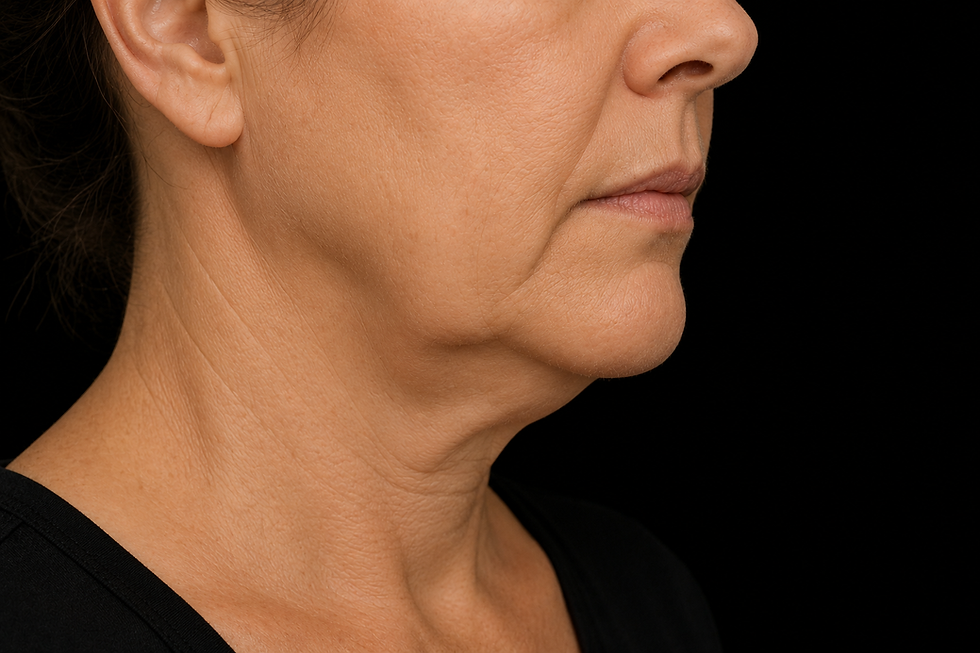
Submental Fat (Double Chin)
While often considered part of facial aesthetics, the area beneath the chin responds particularly well to radiofrequency-assisted contouring.
Reducing localized fat while simultaneously tightening the overlying skin can improve jawline definition and reduce the appearance of a double chin, making this one of the most popular applications of QuantumRF technology.
Treating Multiple Areas
Depending on the patient's goals, multiple areas can often be treated during the same procedure. The exact treatment plan depends on factors such as the size of each area, the amount of localized fat, and the overall duration of the procedure.
During your consultation, a comprehensive assessment will help determine which areas are most likely to benefit and whether QuantumRF is the most appropriate treatment for your individual anatomy and goals.
QuantumRF Body vs Other Body Contouring Treatments
One of the most common questions patients ask is, *"How does QuantumRF compare to other body contouring treatments?"*
The answer depends less on which technology is "best" and more on **what problem is being treated**. Some procedures are designed primarily to remove fat. Others focus on tightening skin. Some require surgery, while others are completely non-invasive. Each has its own strengths, limitations, and ideal patient.
Understanding these differences is essential when deciding which treatment is most appropriate.
QuantumRF Body vs Liposuction
Traditional liposuction remains the gold standard for removing **large volumes of fat**. Through small incisions, fat is mechanically removed using suction cannulas, allowing significant changes in body contour.
However, liposuction is designed to remove fat—it does not directly tighten the overlying skin. Patients with reduced skin elasticity may therefore notice persistent skin laxity after fat removal, particularly if larger volumes of fat are removed.
QuantumRF takes a different approach. Rather than focusing solely on fat removal, it combines **modest fat reduction with radiofrequency-assisted tissue tightening**. While it cannot remove the same volume of fat as liposuction, it may offer an advantage in carefully selected patients where improving skin firmness is just as important as reducing fat.
**Liposuction may be the better choice if you:**
- Have larger areas of excess fat.
- Require significant body contouring.
- Have good skin elasticity.
- Want the maximum amount of fat removed.
**QuantumRF may be the better choice if you:**
- Have small to moderate areas of stubborn fat.
- Also have mild to moderate loose skin.
- Want meaningful improvement with a minimally invasive procedure performed under local anaesthetic.
QuantumRF Body vs Tummy Tuck (Abdominoplasty)
A tummy tuck is fundamentally different from QuantumRF.
During an abdominoplasty, excess skin is surgically removed, weakened abdominal muscles can be repaired, and the abdomen is reshaped. For patients with severe skin redundancy, muscle separation, or significant changes following pregnancy or major weight loss, surgery remains the most predictable treatment.
QuantumRF cannot remove excess skin or repair abdominal muscles.
Instead, it is designed for patients whose skin laxity is mild to moderate and who are not ready for—or do not require—major surgery.
QuantumRF Body vs CoolSculpting®
CoolSculpting uses controlled cooling (cryolipolysis) to damage fat cells, which are then gradually removed by the body's natural processes.
The treatment is completely non-invasive and requires no incisions or internal probes. However, it is designed primarily for **fat reduction** and generally provides only modest improvement in skin tightness.
Multiple treatment sessions are often required, depending on the size of the treatment area and the desired outcome.
QuantumRF differs in two important ways:
- It combines fat reduction with tissue tightening.
- It is typically performed as a single treatment.
Both procedures have appropriate indications, and neither is universally superior. Patients whose primary concern is skin laxity may benefit less from fat reduction alone.
QuantumRF Body vs Morpheus8 Body
Although both technologies use radiofrequency energy, they are designed for different purposes.
Morpheus8 Body delivers radiofrequency through insulated microneedles that penetrate the skin from the surface. It is primarily intended to improve skin quality, texture, and mild skin laxity, and may also help improve the appearance of cellulite in selected patients.
QuantumRF delivers radiofrequency beneath the skin using an internal treatment probe, allowing treatment of deeper tissues and localized fat in addition to stimulating collagen remodelling.
Rather than competing directly, these treatments often address different clinical problems.
QuantumRF Body vs Emsculpt Neo®
Emsculpt Neo combines high-intensity electromagnetic stimulation with radiofrequency energy to build muscle while producing modest fat reduction.
It is designed primarily for improving muscle definition and body composition rather than reducing localized fat deposits or tightening loose skin.
Patients seeking improved abdominal definition or stronger gluteal muscles may be appropriate candidates for Emsculpt Neo, whereas patients whose primary concern is localized fat accompanied by skin laxity may be better suited to QuantumRF.
QuantumRF Body vs BodyTite®
BodyTite is another minimally invasive radiofrequency-assisted body contouring technology that also combines internal and external electrodes to reduce fat while promoting tissue contraction. It is considered the granfather of QuantumRF, and generally requires it to be combined with liposuction.
The underlying treatment principles are similar, and both procedures aim to bridge the gap between liposuction and completely non-invasive body contouring.
The specific technology, treatment protocols, physician experience, and patient selection may differ between systems, making the expertise of the treating physician at least as important as the device itself.
There Is No Single "Best" Body Contouring Treatment
Patients are often led to believe that one technology is superior to all others. In reality, every body contouring procedure has situations where it performs exceptionally well and situations where another treatment is likely to produce a better result.
Choosing the correct treatment begins with an accurate diagnosis.
Is the primary problem localized fat?
Is it loose skin?
Is it weakened connective tissue?
Or is it a combination of all three?
Answering these questions is far more important than choosing a particular device. The goal should never be to fit the patient to the technology, but rather to select the technology that best addresses the patient's individual anatomy, concerns, and treatment goals.
Is QuantumRF Body Right for You?
Body contouring is no longer simply about removing fat. Our understanding of how the body ages has evolved considerably, and we now recognize that changes in body shape are often the result of multiple interacting factors, including localized fat deposits, collagen loss, weakening of the connective tissue framework, and gradual skin laxity.
For many patients, treating only one of these components leads to incomplete results.
QuantumRF Body was developed to address this treatment gap. By combining radiofrequency-assisted fat reduction with tissue contraction and collagen remodelling, it offers a minimally invasive option for carefully selected patients who want more than subtle improvement but are not ready for—or do not require—major surgery.
That said, QuantumRF is not the right treatment for everyone.
Patients with large volumes of excess fat may achieve better results with liposuction. Those with significant loose skin following pregnancy or major weight loss may be better served by procedures such as a tummy tuck or arm lift. Others with excellent skin quality and only a small amount of localized fat may do well with completely non-invasive body contouring technologies.
The key to achieving the best outcome is not choosing the newest device—it is making the correct diagnosis.
Our Philosophy
At Lift Medical Esthetics, we believe that every treatment plan should begin with a comprehensive assessment rather than a recommendation for a specific procedure.
During your consultation, we evaluate:
- The amount and distribution of localized fat.
- The quality and elasticity of your skin.
- The degree of skin laxity.
- Your overall body proportions.
- Your medical history and previous treatments.
- Your aesthetic goals and expectations.
This allows us to determine whether QuantumRF is likely to provide a meaningful benefit or whether another treatment would be more appropriate.
Our goal is never to recommend a procedure simply because we offer it. Instead, we believe patients deserve honest, evidence-based advice and a treatment plan tailored to their individual anatomy.
Book a Consultation
If you are frustrated by stubborn areas of fat, mild to moderate loose skin, or body contours that have not responded to diet and exercise, QuantumRF Body may be an option worth considering.
A consultation is the best way to determine whether you are a suitable candidate and to discuss the range of treatment options available. Together, we can develop a personalized treatment plan based on your anatomy, goals, and expectations—whether that involves QuantumRF, another body contouring procedure, or simply reassurance that no treatment is needed.
The best results begin with the right diagnosis.
**Medical information note:** This article provides general educational information and is not a substitute for an individual medical assessment. Treatment suitability, risks, recovery, and expected results vary with anatomy, health history, treatment area, and technique.
Related Articles
About the Author
Dr. Willem J. Gouws, MBChB, CCFP, FPA
Dr. Willem Gouws is a physician practicing aesthetic medicine in Vancouver and Squamish, British Columbia. His clinical focus includes facial aging assessment, lower-face rejuvenation, structural facial rejuvenation, ultrasound-guided treatments, and skin-tightening technologies. He is a QuantumRF trainer in Canada and is actively involved in developing frameworks for facial aging analysis and treatment planning.


Comments