


Understanding the Jawline: Why Definition Is Lost With Age

Updated: 16 hours ago
Physician | Facial Aging & Structural Rejuvenation
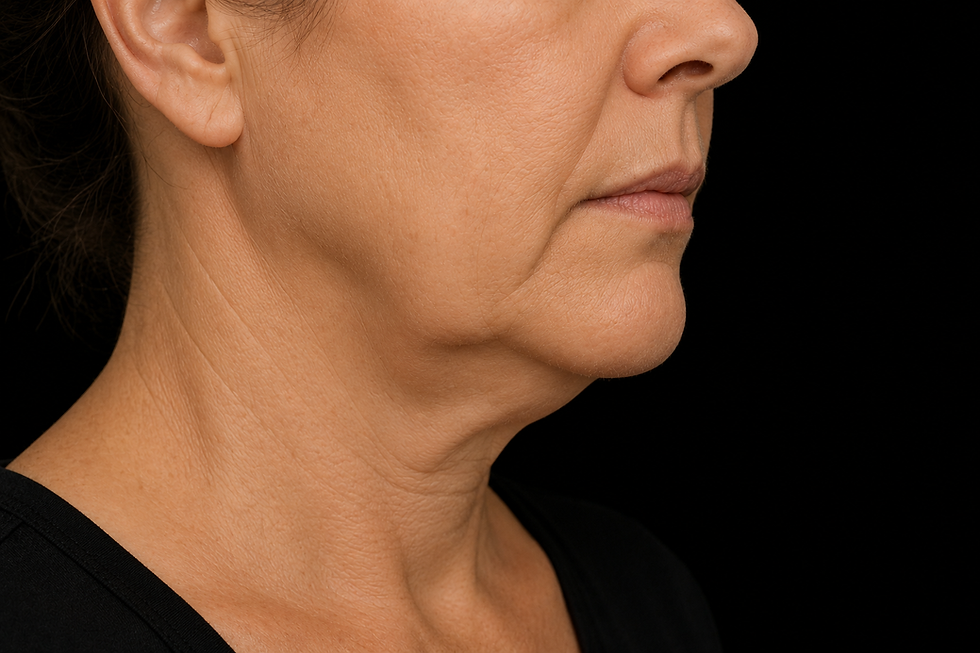
Why Does the Jawline Lose Definition With Age?
Jawline definition is lost as facial tissues descend, structural support decreases, jowls form, skin elasticity declines, and the distinction between the face and neck becomes less pronounced.
A well-defined jawline is one of the most recognizable features of a youthful face and reflects the underlying mechanisms of facial aging.
It creates separation between the face and the neck, contributes to facial balance, and helps define the overall shape of the lower face.
Unfortunately, the jawline is also one of the first areas where many patients begin to notice aging.
Patients often describe:
Loss of definition
Early jowls
A heavier lower face
Neck fullness
Blurred facial contours
Many assume these changes are simply caused by loose skin.
In reality, the loss of jawline definition is usually the result of several aging mechanisms working together.
Understanding these mechanisms is essential for understanding why the jawline changes—and how it can be improved.
Why the Jawline Matters
The jawline acts as an important visual boundary.
In youth, there is typically a clear distinction between:
The face
The jaw
The neck
This creates a clean contour extending from the chin to the angle of the mandible.
As aging occurs, that distinction gradually becomes less obvious. This helps explain why some faces age better than others, even among people of the same age.
The result is a softer and less defined appearance.
For many patients, this is the moment when they begin to feel that their face looks older.
The Jawline Is More Than Skin
One of the most common misconceptions is that jawline aging is caused solely by skin laxity.
The truth is much more complex.
The appearance of the jawline is influenced by multiple anatomical layers including:
Bone
Fat
Ligaments
Muscles
Skin
Changes in any of these structures can influence jawline definition.
This is one reason why different patients require different treatment approaches.
Structural Support Changes
The facial skeleton serves as the foundation of the face.
Throughout life, bone remodeling occurs gradually.
Changes may affect:
Chin projection
Mandibular support
Facial proportions
As support decreases, tissues resting above these structures become less supported.
Although these changes are subtle, they contribute significantly to lower-face aging.
A weaker foundation often results in reduced contour and diminished jawline definition.
Jowl Formation
One of the most important causes of jawline aging is jowl formation.
As tissues descend over time, fullness develops along the mandibular border.
Rather than maintaining a smooth contour, tissue accumulates in areas where it was previously absent.
This creates:
Shadows
Irregular contours
Loss of definition
Jowls are often among the first visible signs of lower-face aging.
Facial Heaviness
Not all patients lose volume as they age.
Some develop a heavy-face aging pattern.
These patients often maintain significant tissue volume but lose contour.
Common characteristics include:
Lower-face fullness
Blunted jawline
Neck heaviness
Reduced facial angles
In these individuals, the issue is often not a lack of volume but rather excessive tissue relative to the available support.
This is one reason why adding volume can sometimes worsen the appearance of the jawline.
Neck Aging and Jawline Definition
The neck plays an important role in how the jawline appears.
A youthful jawline is often associated with a well-defined cervicomental angle—the angle between the jaw and neck.
As aging progresses, several changes may occur:
Tissue descent
Neck fullness
Skin laxity
Muscle banding
These changes reduce the visual separation between the jawline and neck.
Even if the jawline itself has changed only modestly, neck aging can make the jawline appear significantly less defined.
Volume Loss Can Also Contribute
Although heaviness often receives more attention, volume loss can also affect the jawline.
Volume depletion may reduce support in areas such as:
The cheeks
The lateral face
The chin
As support diminishes, lower facial tissues may appear more prominent.
This highlights an important principle:
The jawline is influenced by structures throughout the face—not only the jaw itself.
Why Some People Maintain Their Jawline Longer
Genetics plays an important role.
Patients with:
Strong mandibular structure
Good chin projection
Favorable facial proportions
often maintain definition longer.
Skin quality also matters.
Patients with better collagen preservation and skin elasticity frequently experience slower deterioration of facial contours.
However, even excellent genetics cannot completely prevent aging.
Why Skin Tightening Helps Some Patients More Than Others
Skin-tightening treatments can improve jawline definition in selected patients, although skin tightening results vary depending on anatomy and aging pattern.
The best candidates often have:
Mild to moderate laxity
Early jowl formation
Good structural support
Minimal facial heaviness
When these conditions are present, improvements can be significant.
However, patients with severe tissue descent or advanced heaviness may achieve more limited improvement.
This is why assessment is critical.
When Surgery Becomes the Better Option
For patients with advanced aging, surgery often provides the most dramatic improvement.
A facelift directly addresses:
Tissue descent
Jowls
Neck aging
Jawline contour
Because tissues are physically repositioned, surgery remains the gold standard for restoring advanced jawline definition.
However, many patients are not ready for surgery and may still benefit from appropriately selected non-surgical approaches.
Why Assessment Matters
Two patients may present with the same complaint:
“I’ve lost my jawline.”
One patient may have:
Volume loss
Reduced support
Another may have:
Facial heaviness
Jowls
Neck fullness
The symptom is the same.
The diagnosis is different.
The treatment should reflect that difference.
Final Thoughts
Jawline aging is rarely caused by a single factor.
Changes in structural support, tissue position, volume distribution, facial heaviness, and neck anatomy all contribute to the gradual loss of definition that occurs with age.
Understanding these mechanisms is essential for selecting the most appropriate treatment strategy.
Because successful jawline rejuvenation is not about chasing symptoms.
It is about understanding why the jawline changed in the first place.
Medical information note:** This article provides general educational information and is not a substitute for an individual medical assessment. Treatment suitability, risks, recovery, and expected results vary with anatomy, health history, treatment area, and technique.
Related Articles
About the Author
Dr. Willem J. Gouws, MBChB, CCFP
Dr. Willem Gouws is a physician practicing aesthetic medicine in Vancouver and Squamish, British Columbia. His clinical focus includes facial aging assessment, lower-face rejuvenation, structural facial rejuvenation, ultrasound-guided treatments, and skin-tightening technologies. He is a QuantumRF trainer in Canada and is actively involved in developing frameworks for facial aging analysis and treatment planning.


Comments